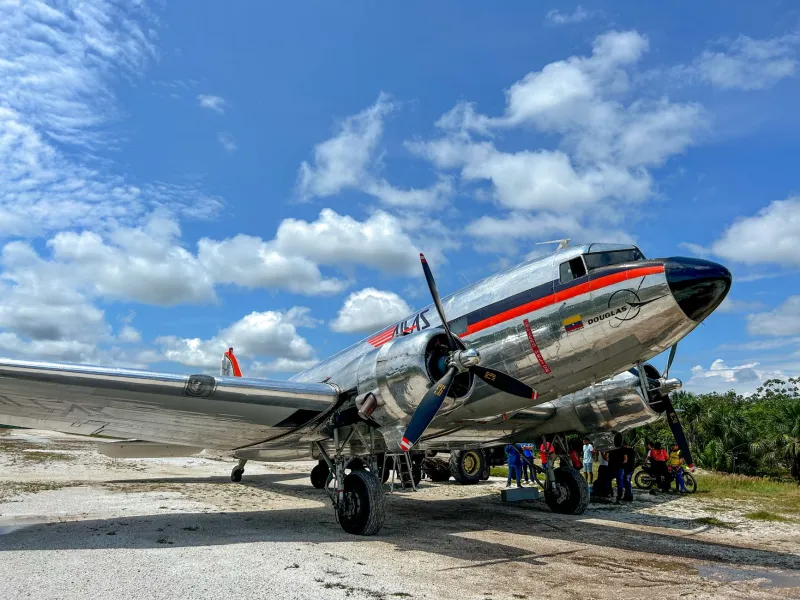
From Sleeper Car to Sky Road: The Douglas DC-3 and the Birth of Everyday Air Travel
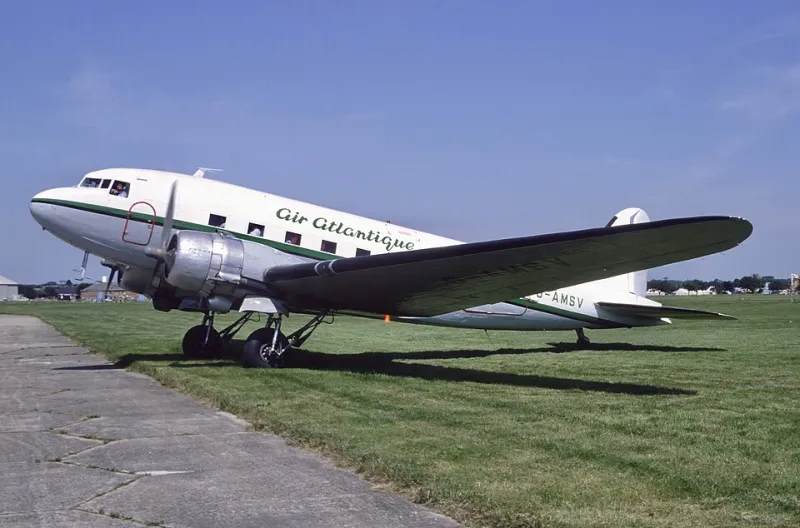
Photo: Colin Cooke Photo, CC BY-SA 2.0, via Wikimedia Commons
In the summer of 1936, American Airlines placed its first Douglas DC-3 into scheduled service between New York and Chicago. The flight carried passengers in upholstered seats, arrived on time, and turned a modest profit. None of that sounds remarkable today. In 1936, it was something close to a miracle.
The DC-3 did not set out to revolutionize anything. It was designed to solve a specific, unglamorous problem: how to make sleeping berths comfortable enough that wealthy passengers might choose an airplane over an overnight train. What emerged from that narrow brief was an aircraft so fundamentally capable that it reshaped the entire architecture of American commercial aviation—and did so almost entirely by accident.
A Brief That Outgrew Itself
The story begins not with Douglas, but with American Airlines president C.R. Smith and a late-night phone call to Donald Douglas in 1932. Smith wanted a sleeper aircraft that could carry passengers coast to coast with minimal stops. The result of that conversation was the Douglas Sleeper Transport, or DST—a wide-fuselage, twin-engine monoplane with berths for fourteen overnight passengers. It was a capable machine, but its true potential was hiding in plain sight.
When engineers reconfigured the DST's cabin to remove the sleeping berths, they discovered something unexpected. The same airframe that had been designed to carry fourteen sleeping passengers could comfortably seat twenty-one in standard chairs—and still fly profitably. That reconfigured version was designated the DC-3, and it changed everything.
Before the DC-3, commercial aviation in the United States was a precarious business. Airlines survived largely on government airmail contracts, not passenger revenue. Carrying people was, in many respects, an afterthought. Ticket prices were steep, aircraft were cramped and unreliable, and the experience of flying was loud, cold, and frequently terrifying. The passenger was tolerated rather than courted.
The Economics of Revolution
What the DC-3 introduced was something airlines had never quite achieved before: the ability to make money carrying people without depending on mail subsidies. Its operating economics were genuinely transformative. The aircraft could carry enough passengers over enough distance at low enough cost that a ticket price within reach of the American middle class could still yield a profit for the carrier.
By 1939, the DC-3 accounted for roughly 90 percent of all commercial air traffic in the United States. That figure alone tells a significant story, but the more revealing number is what happened to passenger volumes during the same period. Americans who had never considered flying—who associated aviation with barnstormers and stunt pilots and wealthy adventurers—began booking seats. The DC-3 did not merely improve commercial aviation; it created the market that commercial aviation needed to survive.
Route networks expanded in ways that would have seemed implausible just a few years earlier. United, TWA, Eastern, and American all built their domestic systems around the DC-3's range and reliability. Cities that had been connected only by rail or road found themselves within a few hours of one another by air. The psychological map of American geography began to contract.
Reliability as a Cultural Argument
The DC-3's technical qualities mattered enormously, but their significance was as much cultural as mechanical. Earlier aircraft had been unreliable in ways that were not merely inconvenient but genuinely dangerous. Passengers understood that delays, diversions, and accidents were routine features of air travel, not aberrations. That understanding kept the market small.
The DC-3 was not infallible, but it was dependable in a way its predecessors had not been. Its two Pratt & Whitney or Wright radial engines provided redundancy. Its low-wing monoplane configuration offered stability. Its robust construction tolerated the kind of hard use that came with daily scheduled service across a country whose weather was rarely cooperative. Mechanics found it straightforward to maintain. Pilots found it forgiving to fly.
That reliability gradually altered public perception. When an aircraft consistently does what it promises—departs on schedule, lands where intended, delivers its passengers intact—it stops being an adventure and becomes a tool. The DC-3 was the first American airliner that most passengers experienced as a tool rather than a gamble, and that shift in perception was the foundation on which the entire postwar aviation industry was eventually constructed.
War, Surplus, and an Unintended Legacy
The Second World War extended the DC-3's reach in ways its designers could never have anticipated. Pressed into military service as the C-47 Skytrain, the aircraft became one of the most widely produced and extensively operated military transports in history. It dropped paratroopers over Normandy, supplied troops across the Pacific, and flew over the Himalayas on the China-Burma-India route that crews called the Hump.
When the war ended, thousands of surplus C-47s flooded the civilian market at prices that small regional carriers could actually afford. This democratization of aircraft ownership created a second wave of route expansion, reaching communities that the major carriers had never served. Towns across the rural South, the Mountain West, and the upper Midwest suddenly found themselves connected to the national air network—not because of grand strategic planning, but because a surplus military transport happened to be available cheaply and happened to be exactly what those routes required.
That postwar surplus also seeded aviation industries across the developing world. DC-3s flew in South America, Africa, Asia, and the Pacific, frequently operating routes where no other aircraft could have functioned economically. Some remain in service today, a mechanical longevity that speaks to the fundamental soundness of the original design.
What the Designers Did Not Know
Perhaps the most instructive aspect of the DC-3's history is the gap between intention and consequence. Donald Douglas was solving a specific problem for a specific customer. C.R. Smith was trying to compete with the railroads on overnight routes. Neither man was attempting to construct a new paradigm for long-distance travel. They were, in the most practical sense, trying to run a business.
The lesson that aviation historians and preservationists return to repeatedly is not that the DC-3 was the product of visionary genius—though it was certainly the product of considerable engineering skill—but that its consequences were essentially unforeseeable from the vantage point of its creation. The aircraft that accidentally invented commercial aviation did so by being genuinely useful, consistently reliable, and economically honest. Those qualities, it turned out, were sufficient to change the world.
At the World Heritage Air Museum, the DC-3 occupies a place in our understanding of aviation history that goes beyond technical achievement. It represents the moment when flight stopped being a spectacle and became a system—when the sky ceased to be a frontier and began to function as infrastructure. That transformation, quiet and largely unannounced at the time, altered the rhythm of American life in ways we are still navigating today.